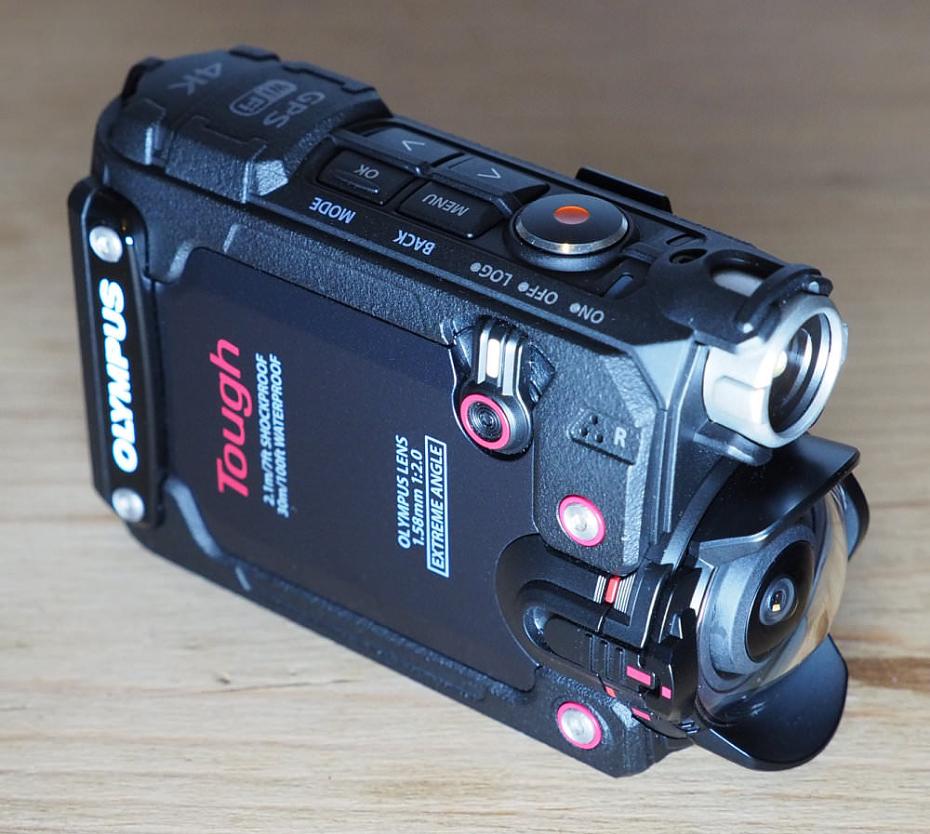
With its unusual TG Tracker, Olympus takes its long-running TG-series of Tough-branded cameras in an altogether rather different direction. The company is billing Insta 360 camera the TG Tracker as a “rugged experiential camera”, and points at the wearables market as an indication of the public’s desire for ever more data — something the Olympus TG Tracker should provide in spades.
To our mind, the TG Tracker is reminiscent of a GoPro camera, but taken to its logical conclusion. It keeps the action-friendly rugged design typical of an action camera — or perhaps a little more so, since no water and shock-resistant housing is needed — and then adds the ability to capture a constant black box-style stream of data throughout video recording.
If you’ve ever wanted to know — and prove to your friends and family — just how deep you were diving when you reached that shipwreck, how high you soared in your glider flight, how far you hiked along that mountain trail, how cold it was at the top of that piste or how fast you were traveling as your bike tore down that trail, then this is the camera for you.
As you’d expect of the Tough series, the Olympus TG Tracker is ultra-rugged
Olympus’ TG-series cameras have developed quite a name for themselves in the rugged camera segment, thanks to some seriously solid build quality. The Olympus TG Tracker is no different, promising to take a beating and keep on shooting without the need for an external housing of any kind.
Straight out of the box, the TG Tracker is waterproof to depths of 100 feet (30m), shockproof for a drop from as high as seven feet (2.1m), and crushproof to a force of 220lbf (100kgf). It’s also said to be both dustproof and freezeproof to 14°F (-10°C).
All those sensors allow for some pretty cool features
For one thing, the Olympus TG Tracker allows you to record data from all of its many Field Sensor System inputs all of the time, much as some cameras allow you to capture a continuous GPS track log. But instead of recording just your location, the TG Tracker will also let you know what your direction, speed, altitude or depth and ambient temperature were at any given point along the way.
Although we’ve yet to see specific figures, power consumption for this functionality is said to be “minimal”, and there’s a dedicated external control with which to enable or disable logging. Logs can be viewed on the camera’s own screen, or on your smart device or computer post-capture.
Manage video chapters based on the TG Tracker’s accelerometer
The accelerometer, meanwhile, enables the TG Tracker to automatically tag recorded videos with chapter information, making it easy to skip forwards or backwards to the interesting points.
This optional function operates on a fairly simple and logical assumption: If there’s a big spike in recorded G forces, something interesting is probably happening. You can set a threshold level of 4G or 7G, and if this value is exceeded — because you just landed a jump on your bike, say — then a chapter tag will be added to the video at that point.
The Olympus TG Tracker’s second lens is a flashlight
Another unusual feature of the Olympus TG Tracker becomes immediately obvious at a glance. It looks for all the world as if there are two lenses on the front of the camera, one of them big and one a bit smaller. In actual fact, the upper “lens” is an LED-powered flashlight, used to provide a constant illumination source for video capture or a brief “flash” for photos.
This flashlight is also used to provide what Olympus is calling a “headlight” function, enabled even when the camera is powered off by holding in the Info button. You have a choice of two brightness levels — either 30 lumens for 30 minutes, or 60 lumens for one minute. At 30 lumens, the flashlight should have a three foot (1m) range, and at 60 lumens, that increases to 10 feet (3.5m).
 Site Title
Leave a comment